Sampling Popular Culture at MegaHalloween

Halloween 2022

This essay first appeared in the West Volusia Beacon on November 29th 2022, https://beacononlinenews.com/2022/11/29/learning-across-generations-at-mega-halloween/.

After two years of Covid-clouded Mini-Halloweens, we were back to Mega-Halloween on Minnesota Avenue in DeLand, and not just with big numbers of kids of all ages in a wild array of outfits. Neighbors who had bowed out recently were in full party mode with mega-decorations, free food to go along with the abundant treats, and even the return of a Karaoke stage.

As the Neighborhood Nerdy Professor, I met the costumes containing trick-or-treaters on “our” front lawn and invited my students to join in the fun with a purpose. I say “our” because, in June, after 35 years, I sold the house at Halloween Central. Before the closing, I asked the new owners if I could return on Halloween night. “Oh yes,” they said, “please do!” So we had an extra-big party, with mingling of old and new, on “our” front lawn.
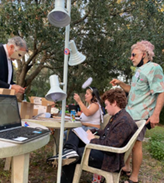
(from left to right) The Father of Phantom of the Opera (aka, Sims Kline) checks out some non-candy treats with Ariana Giuliante, Sowren Wildingcrayne, and Mr. Frizzle, the unknown alter ego to Ms. Frizzle of “Magic School Bus” fame (aka, Paul Croce).

My classes are devoted to understanding American history and culture. On inviting my students to join us—if you dare!—at sundown on October 31st,  I said to the college-age big kids, “Let’s talk to the kids, since they have culture too. How do they develop their ideas?” On the lawn, we made note of the outfits and any funny stuff they said. What’s the most popular outfit of the year? What’s it gonna be? Got guesses?

It was fun to talk with the little kids and to take some deep dives into current popular culture. I learned a lot from the college students, especially Adrian Cerrud, Ari Giuliante, and Sowren Wildingcrayne. On the border between childhood and adulthood, they educated me about popular movie and video game characters. In the spirit of Oberlin College Professor David Orr, who highlights the special opportunities in young adulthood for planning vocations, college students are young enough to jump into the fantasy stories but old enough to understand Halloween’s dark and playful spoofing in relation to actually serious problems. Looking through the eyes of my students, Halloween this year was serious fun.

The parents in one family said they like coming to Minnesota Avenue because it’s the safest neighborhood, to which the kids shouted, “and the best candy.” I veered from that tradition by supplying some dentist-approved temporary tattoos and pencils saying “MegaHalloween DeLand USA” along with Fair Trade candies. For many of the grownups, Halloween was party time. While their children were all business “excited to get candy,” as one of them put it, many of the parents were “here for the boo’s,” as the shirt on one father read, while a woman proudly displayed “Booz-o-ween 2022.” One man summed up the generational divide, “It’s a lot more fun at ten years old than at forty-eight—unless you have a cocktail!”

Another student, Devin Hernandez, turned the evening into an anthropology field experience with the mentorship of Anthropology Professor Ana Servigna. Rather than study humanity living in a different era or in some far-flung place, study the people around us, right here and now, including with thoughtful self-reflections. During years of trick-or-treating, “as a child, I had never asked,” he observed about himself “about … unspoken assumptions.” Then he witnessed them during Halloween rituals: kids knew to “form single-file lines without being told.” Similarly, college learning is a chance to raise questions about our still bigger unspoken assumptions. Learning to make the strange familiar and the familiar strange offers opportunities to think about those assumptions. Then, with an examined life, you can construct your own mental GPS or put those assumptions back in mind. While making those choices, college gives a chance to understand your own thoughts in relation to how others think.

At our Halloween rituals, children of all ages got a lot of playful lessons from the stylized terrors of bloodied zombies and grim reapers. Grim? Yes, and as with a lot of the troubles all around us, we can’t individually solve these massive problems: addiction, crime, environmental destruction, warfare, and more wickedly difficult problems and moral burdens. Halloween reminds us that in joint efforts, as with the masses of people that night, we can make mega impacts.

            And speaking of big numbers, what was the most popular outfit this year anyway? The Minnesota Avenue answer to that puzzle, with calculations based on those who tolerated the eggheads chatting it up with the ghouls and goblins, is … Pirates, followed closely by the rest of the Top Ten:

22        Pirates

18        Spidermen

17        Jack Skeletons

16        Clowns

16        Purgers

14        Skeletons

13        Police Officers

13        Witches

12        Foxes

11        Skaters

Is there renewed hope for the world with Angels outnumbering Devils 10 ½ to 6 ½? (One character was Half Angel, Half Devil.) And one of those Devils may not qualify because “my mom thinks I’m a witch.” Some people have a devil of a time being themselves.

Lots of people didn’t make it to the Top Ten, but they join Top Five Prizes for Creativity:

The Prize for Social Commentary goes to Lazy American Worker

The Cheerful Award goes to the Happy Scientist

The Anachronism Award goes to Astronaut Sailor

The Prize for Seizing Self Worth goes to the person saying “I’m not just a mom; I’m a cool mom”

The Prize for Existential Chin Puller goes to the person reporting, “I’m my child’s shadow”

For all the tricks of recent life, what treats can we pull from the treasuries of imagination displayed on Halloween night?

-Croce is Professor of History and Director of American Studies at Stetson University, and the author of Young William James Thinking. He writes for the Public Classroom and his recent essays have appeared in Civil American, History News Network, Huffington Post, Origins, Public Seminar, Stetson Reporter, US Intellectual History Blog, Washington Post, and West Volusia Beacon. Mega thanks to Michael Bernier, Caitlyn Bishop, Mary Brandt, Adrian Cerrud, Shiloh Conway, Ari Giuliante, Devin Hernandez, Katie Kraft, Jake Mcgillivray, Sam Mudge, and Sowren Wildingcrayne who assisted with interviewing trick-or-treaters and organizing the project. 

Standard
Essays

Halloween 2020

Halloween Year Meets Halloween Night

Published in West Volusia Beacon, November 5-11, 2020

In 2020, every day has been like Halloween. It’s been a year of scares and shocks. President Donald Trump making surprise his daily fare. Joseph Biden in fourth place in early primaries; Joseph Biden the Democratic Party nominee for president. A novel Corona Virus silently infecting millions, killing hundreds of thousands, and shocking the economy. And that’s just the US. A year with the most big-ticket disasters in US History—and there are still two months to go.

Is there room for any more shock?

Actually yes. The virus could take a more deadly turn. The shutdown economy could hurt more people. The fire season in the west and the hurricane season in the east still have months to go. In a nation closely divided, half are going to be hurting after the election.

Enter a night with dark visions of mysterious powers and scary creatures. It’s 2020 to the max. Like Aladdin at the end of his movie pulling the evil Jafar into one little lamp, Halloween is a chance to pull all our fears into a stylized exaggeration of our Year of Living Scarily. Halloween is a night for dressing up our scares, living them out, and then putting them away at the end of the evening.

Read the whole essays in the West Volusia Beacon [external link]

Standard
Private Life With Public Purpose

Satire: A New University Logo: NO TESTS

Originally featured in The Stetson Reporter, and can be read in its original format here!

Professors have lots of papers and tests to grade. For most, it’s the least-fun part of the job. When weighed down with a big stack of student work, this professor at Stetson University saw his university in a new light.  

Maybe it was all the grading that made me see things backward…. Maybe it was just mid-semester fatigue…. Or maybe it was a mental symptom of the novel coronavirus….

Staring up from the papers and books, the Stetson University logo caught my eye. We’ve all seen it: those familiar seven big green letters on the university seal, or with the word “University” holding them up and braced by a big elegant dot on each side, or next to one big S with a swoosh in the middle. I saw the word, “STETSON,” as I had seen it many times, but now, as if with a Rorschach test in reverse, I saw it with new eyes….

The green shapes floated and bobbed before my eyes. The letters in reverse seemed to grope toward a message, as if with words that were waiting to be spoken: NOSTETS. I rubbed my eyes…. No, what?

It didn’t make sense; maybe it was nothing. Back to grading…. But the letters kept calling out…. They danced around each other, and then it hit me like a ton of blue books: NO TESTS!

Was it wish fulfillment? What could be a greater wish when swamped in grading than to wish for … no tests—no essays to grade—no more answers to scrutinize—no more grading! And then I realized: The was no simple wish or idle dream. It was an inspiration that needed to be broadcast from the height of The Rock and beyond.

How can a mid-sized liberal arts college with a former denominational affiliation distinguish itself in a crowded educational marketplace? What can we do here that will so catch the eyes of prospective students that they will crave their studies here? What do students really want? These have been the questions of countless questionnaires and administrative meetings. The answer was simplicity itself: NO TESTS.

Continue reading
Standard
Sampling Popular Culture at MegaHalloween

Halloween 2019

Children’s Culture at Halloween: Be More Than You Can Be

Published in the Society for US Intellectual History Blog, November 30, 2019, https://s-usih.org/2019/11/childrens-culture-at-halloween-be-more-than-you-can-be/

In case you are wondering where kids get their ideas for Halloween costumes, I have a modest proposal.  Consider the large sample in the small town of DeLand, Florida.  With over two thousand children dressed up on Halloween night in my neighborhood, I invite friends and students to join in the fun with a purpose: where do kids get their ideas for being Themselves 2.0 for a night of Trick-or-Treating?

Continue reading

Standard
Popular Culture and Cultural Politics

Two Cheers For Steve Levitsky

On Tuesday, February 19, students, professors, and community citizens filled the better part of the Stetson Room to hear Steven Levitsky. He is Professor of Government at Harvard University and coauthor with department colleague Daniel Ziblatt of the best seller, How Democracies Die (2018).  Levitsky’s presentation lived up the dramatic intensity of his book.  He provided a keen analysis of our present political weirdness: in the words of Stephen Stills, “somethin’ happenin’ here; what it is ain’t exactly clear” (Buffalo Springfield, “For What It’s Worth,” 1967, https://www.youtube.com/watch?v=gp5JCrSXkJY).  Levitsky provided a lot of clarity.  

Levitsky is worried about the erosion of democracy. Having studied democracies around the world, in health and in decline, he sees erosion in American “democratic norms” (100). The central agent of democratic decline, he suggests, is the sharpening polarization of political views.

Continue reading
Standard
Private Life With Public Purpose

How to set New Year’s resolutions that maximize happiness

Originally published on December 31, 2018 in the Washington Post, which can be found here: https://www.washingtonpost.com/outlook/2018/12/31/how-set-new-years-resolutions-that-maximize-happiness/ 


Millions of Americans will make New Year’s resolutions. Some will vow to make more money or new friends. Others will focus on exercising more or eating less. Each resolution represents the hope that changing one’s behavior or priorities will bring increased happiness.

Continue reading

Standard
Sampling Popular Culture at MegaHalloween

Halloween 2018

Choosing the Halloween Outfit: The Second Most Important Election of the Season

Published as “Time for Some ‘Funner’ Voting,” DeLand Beacon, November 9-25, 2018

Elections are important.  But they also wear us out.  All the ads and flyers and promises—and we can only hope that the winners actually do the stuff they promise.

Time for a funner election—that’s a fun word my children taught me.  For this election, can you guess the most popular outfit of the year at MegaHalloween on West Minnesota Avenue in DeLand?

Continue reading

Standard
Private Life With Public Purpose

Feeling Overwhelmed by What’s Happening?

Originally published on September 23, 2018 in the History News Network; full article can also be read here: https://historynewsnetwork.org/article/169822


As a young man, William James studied a range of fields, from chemistry to literature. He focused especially on physiology, psychology, and philosophy. In the 1860s and 1870s, the future psychologist and philosopher was sorting out his own philosophy of life and sampling career paths. Each offered plausible insights, but none was decisive or beyond some criticism, especially as amplified by his temperamental indecisiveness. The swirl of choices, and the dramatically different ways of understanding the world, made him feel downright “dead and buried.” With these burdens, compounded by severe depression and poor physical health, he even vowed never to marry lest his problems descend to another generation. By his late twenties, he felt “rather precipitately old.”

Continue reading

Standard
Private Life With Public Purpose

The Scripture in the Stone:Preparing for adulthood in the new old-fashioned way

Originally published on July 19, 2018 through Public Seminar; original can be found here: http://www.publicseminar.org/2018/07/the-sculpture-in-the-stone/

William James’s Hard-Won Development Between Childhood and Fame

How do we come of age? The Pew Research Center reports a steady increase over the last five decades in the number of young adults, aged 25 to 35, living with their parents. The percentage of young people “nesting” at home has almost doubled since 1964, up to 15 percent of this age group in 2016. Economic factors have encouraged these living arrangements, including the difficulties of breaking into the labor market, the high cost of independent living in many areas, and soaring debt obligations.

Continue reading

Standard
Sampling Popular Culture at MegaHalloween

Halloween 2017

MegaHalloween, DeLand, USA: Trying on Identities

This essay also appeared in the Stetson University student newspaper, Hatternetwork, November 18, 2017, http://www.hatternetwork.com/arts_culture/megahalloween-deland-usa-trying-on-identities/article_7bb073fa-cc73-11e7-bd79-cbcaad1ce9a1.html,

And, with the title “A Time to Try on New Identities,” in the West Volusia Beacon, November 20-26, 2017, page 7A.

Halloween was as big as ever on Minnesota Avenue, with about 2,000 creepy and cute outfits adorning people from far and wide and from many social backgrounds.  This year, students from my Modern US History class joined me on my front lawn to talk with our animated visitors about how they think up their ideas.  Continue reading

Standard