Uncategorized

English–to go!

This was originally published on July 9, 2013 by the Society for U.S. Intellectual History, and can be viewed in its original format here: https://s-usih.org/2013/07/english-to-go/ 

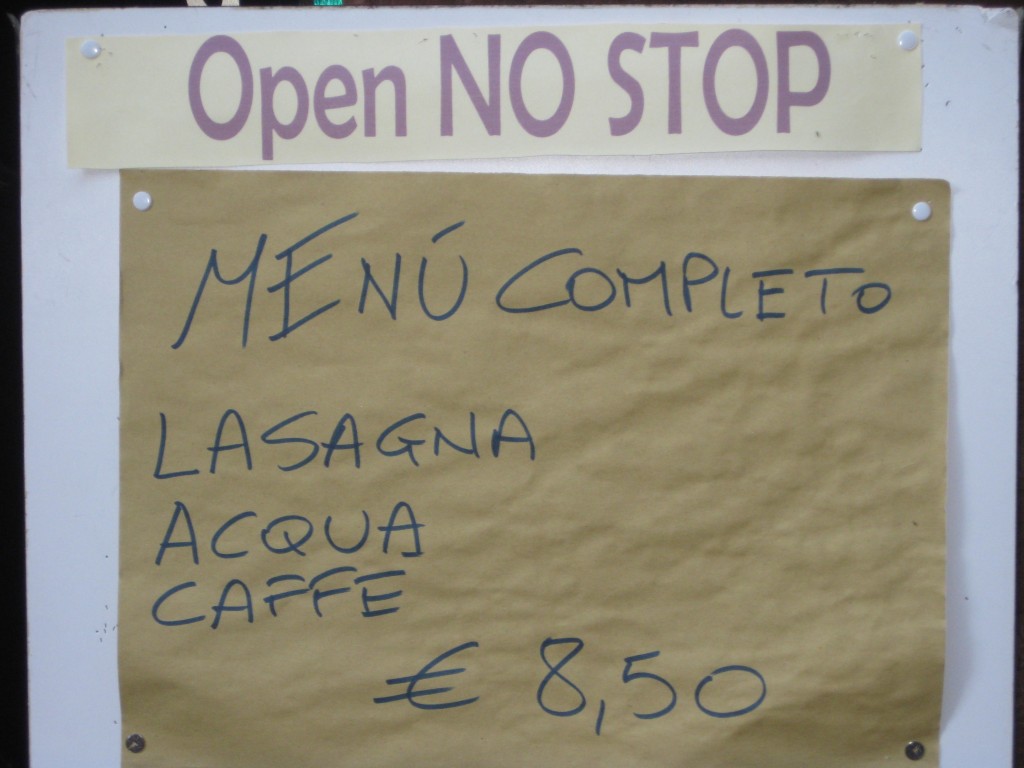
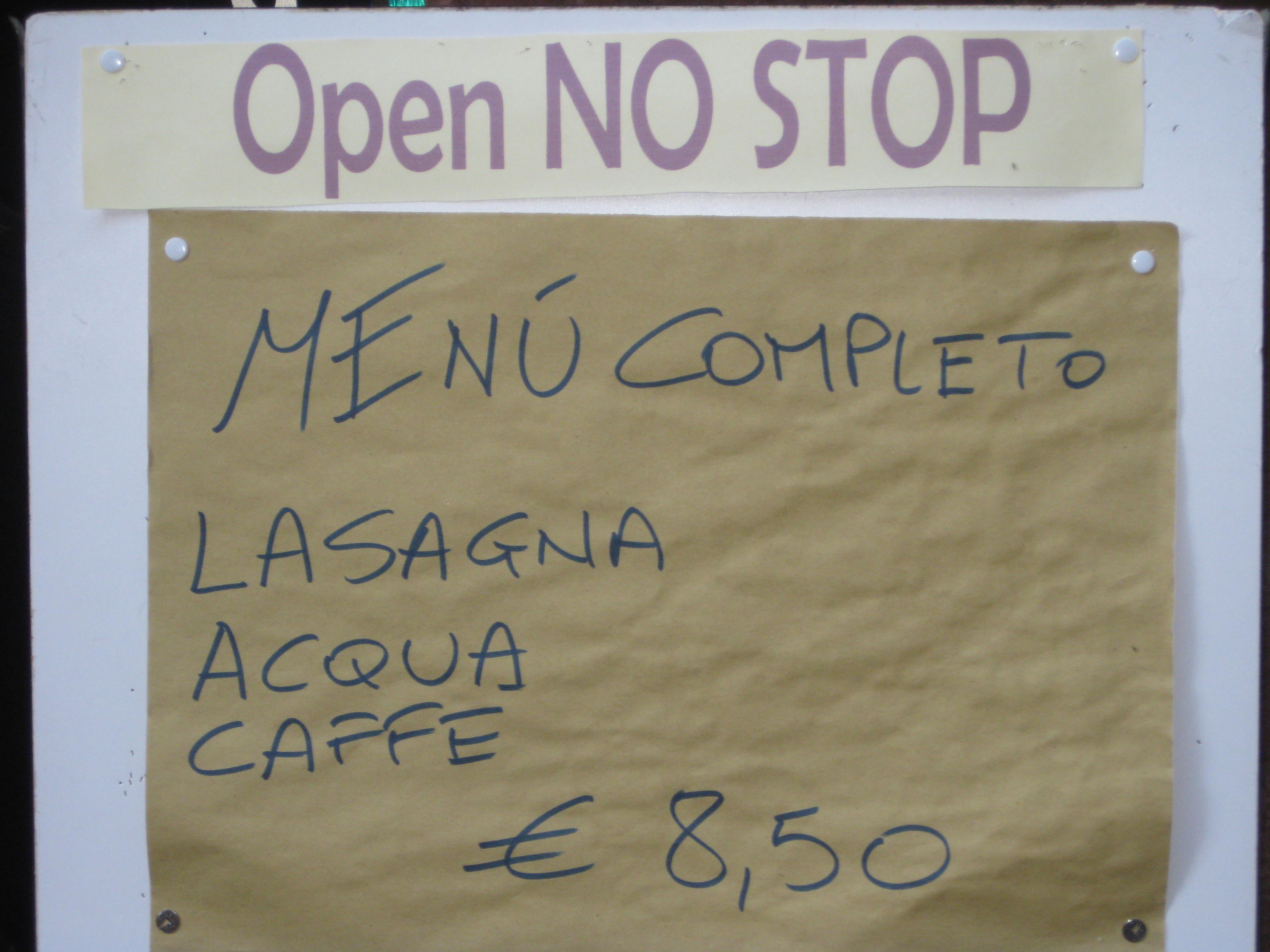
Spending the spring semester teaching in Rome, I felt very spoiled.  Not only was I teaching the history of my country in my native language, but also, I kept bumping into English words on the street.  The globalization of English includes not only more people speaking this language of British Empire and American influence, but also more people using English words in the everyday speech of their home country.  Ecco Roma. 

Especially for conveying things fast and hip and most especially, things for sale, many signs in Italy’s capital include a few bold English words for punchy impact.  This is a little surprising since most Italians do not speak English very well, although that does vary by generation, with young people generally having more command of the language.  Asking for directions in the Metro subway offered an example: using the best Italian I could muster, I asked an older man, “mi scusi, dov’è linea B? [excuse me, where is line B?]” and he just said, “non parlo inglese”; he wouldn’t even stoop to my English-accented Italian.  Then a young person nearby seemed very proud to be able to answer my question, though in very basic English.  The English on the streets speaks to Italian aspirations for learning English and enjoying American culture, and to some extent British culture too, most notably with the continued popularity of the Beatles.

Some of the English in Italy is associated with the American Western frontier, which has a more powerful appeal here than in the present-day US.  The Marlboro Man still rides on posters, and an ad for sunglasses shows two men in action during a rodeo with a bull coming at them; they look ready for action in their shades, and the caption reads simply “Never hide.”  With a picture of the open range in the background, a car ad declares “Life is an open road.”  Another car ad sells both “Motion and emotion,” while another challenges prospective buys to “Start something more than a car.”

English seems to be the vehicle of choice for conveying anything energetic.  A phone company promises “Power to you,” but the fine print in Italian specifies the amount of money to them.  A photography school is looking for students, but specifies that study there “Requires passion.”  There’s a bar called the “150mph Club,” and once I found my way on the subway lines, I caught a glimpse of graffiti on a train car that summed up this theme: “Life is Fast.”

English also provides the words to use for things trendy and cool.  There is a pizza parlor called “Retro,” and an image at a shoe store of a sultry young woman biting on a sneaker seductively because, well, “It’s a sneaker thing.”  Another ad displaying a beautiful woman as a “Dior Addict,” was not to promote rehab clinics; instead, the caption told the story: “Be Iconic”; but the sheers numbers of this iconic woman and the prospect of big sales to women who then might all look like her made me think that the caption should read “Be Cloned.”  A poster of a woman modeling jewelry displays the unusual combination, “Virtuous-Sensuous,” with more of the latter on display; the jewelry company is acknowledging the power of goodness and beauty, and now just needs to reckon with the true.

English is used most for selling things.  There are signs that invite “Smart shopping,” that offer a “Special price for a special customer,” that tempt with “Must-haves for everyday,” or that simply blurt out “Think trench.”  And the clothing stores feature a “New collection,” “Fashion in the air,” or outfits with a “Sensual fit.”  Some of the English is so thoroughly incorporated that the signs seamlessly mix the two languages, such as the store that’s a “Shopping casa,” and another one selling “Scarpe [shoes]—to go!”  There is enough comprehension of English to allow even for some intentional misspelling for effect; one store invites each shopper to “Be yourslef”—freed even from the conventions of spelling!

Tee-shirts seem to be the place to blurt out something American, but sometimes without a clear meaning.  In addition to the authentic college logos, there was one that looks at a distance like the circular seal of an American college, but close up, it reads, literally, “City, State University”—that generic American college thing.  One shirt states “Box—New—Fun” (still trying to figure that one out), and another declares “No alcohol.  Yes love.  Happiness.”  One other shirt may be a clue about Italian environmentalism; it reads “Save the planet—it’s the only one with chocolate.”  That is actually the color of the Tiber River running through the center of the city, and the branches of the trees on its banks are full of debris that the trees have caught at high water—trees as filters!  But apparently the river is not too far gone since sea gulls and human fishers still work the river.

Many of the signs in English combine their goal of sales promotion with slightly off-tune use of the language to make for downright charming phrases.  A sign for discounted prices reads “Happy price—make your life happy,” and another store boasts “All-inclusive big.”  There is a sign for “Juice shoes,” which may explain what that sultry sneaker woman was going for.  One fashion boutique boasts simply “So style,” and a massage parlor at the airport sits under a sign that states “Be relax.”  But my favorite is the sign on a trash can at an ice cream parlor that asks customers to “Share happy with planet.”

These displays of English on Roman streets show recent chapters of the spread of English, and they also show how American culture is perceived in Italy.  Advertisements are the texts of maximum transparency; in their urgency to sell, they use words bluntly—with meanings … to go!  English offers many of the words of choice, especially when the message is high fashion or high speed.  This medium may not be the message that all Americans have of their own culture, but that is the message that Italians are finding and seeking out about American culture.

I found confirmation of this street reputation of American culture when I asked my students about their impressions of the United States.  They referred to intensity and efficiency, to abundance and an easier life, but they also referred to opportunities and the capacity for personal reinvention.  American culture may often seem to be one grand commercial bazaar and awash in a politics of paralyzing gridlock, but it also possesses at its core a setting for new possibilities that may be the nation’s most enduring product.  And if anyone doubts that democratic potential in the USA, just ask anyone on the street in Rome.
when in rome

Standard
Popular Culture and Cultural Politics

Democracy’s close watch on our government’s reputation factory

Originally published on July 4, 2013 in the Orlando Sentinel; which can be accessed here: https://www.orlandosentinel.com/opinion/os-xpm-2013-07-04-os-ed-nsa-snowden-070513-20130703-story.html

This piece can additionally be read as a .PDF here.

Most Americans have been aware of government surveillance for security purposes, but few realize the extent of these programs.

Continue reading

Standard
Popular Culture and Cultural Politics

Unsustainable Politics, 2012

This piece was originally published in Volume 5, Issue 6 of the Sustainability journal. 

There were no ads during the presidential debates. This is the exception that proves the rule in modern America. Nascar drivers broadcast their endorsing companies across their outfits, and the rest of us more subtly wear logos of brand-name clothing.

Advertisers study us very closely to know just what we want; beneath our talk and even our thoughts, what will we pay for? In soccer, the eyes don’t announce a player’s next move, but the feet will. So to understand the political choices that were offered to us during the 2012 election season, don’t just look to the party platforms, the political speeches, the debates, or even the political ads presented during the most richly funded campaigns in world history. Look to the ads for other products.

To continue on, click here.

Standard
Sampling Popular Culture at MegaHalloween

Halloween 2012

Halloween on Minnesota Avenue: The Imagination Factory

The West Volusia Beacon, November 15-18, 2012, p. 1B

On October 31st, Minnesota Avenue was as full as ever with costumes and carnival delights. Some houses featured fanciful lawn decorations and music and lights, hot dogs and other treats, and of course candy, lots of candy. The crowds swelled—there must have been about 2000 people on the street and lawns.
As the token eggheads, I and two patient and playful neighbors, Blake Jones and Sam Valdez, persisted with the simple delights of meeting the kids of all ages on my front lawn, but with our mere Gang of Three to do the greeting, we turned more to talk and less to counting. Like the pollsters during the recent elections making predictions based on the returns of only a few precincts or interviews, our estimates of popular outfits come from the mere 800 that we actually could meet…. Continue reading

Standard
US in the Middle East / Middle East in the US

Recalling 9-11: Between values, violence

September 2012

With all the suffering and destruction of 9-11 in 2001, when the United States was brutally attacked, the results also produced a peaceable possibility. Even the French Le Monde newspaper gushed with a sympathetic headline, “We are all Americans.”

Then-president George W. Bush liked to talk of “political capital,” and the U.S. had it in abundance, a potential resource for tackling the roots of those hatreds, to isolate and humiliate the terrorists, to build a more constructive basis for resolving tensions in the Middle East.

Led by that same president, the U.S. took another path, fighting fire with fire, seeking revenge on Osama bin Laden and the al-Qaida terrorists, and declaring an endless war on terror, directed at the hiding terrorists, and then expanded with another war.

A look at the rest of this essay serves to begin a conversation about where 9/11 fits into our collective history.

Standard
Sampling Popular Culture at MegaHalloween

Halloween 2011

Halloween: Carnival Day for Children’s Imaginations

The DeLand Beacon, November 17-20, 2011, p. 5A

Halloween is a day of the child. Most days, children have to do what they are told, or even try to be someone who doesn’t come naturally to their natural impulse: follow rules, learn challenging things, play to win. Halloween is a day for them to follow their imaginations, learn fun things, and play just to play. Continue reading

Standard
William James Coming of Age

The Social Value of William James

September 2011

William James (1842-1910) died one hundred years ago this last month. My study of his life and work has been a liberal education worthy of Stetson’s mission.

His career spans the arts and sciences. He resolved first to be a painter, beginning at age eighteen in the art studio of William Morris Hunt. He had a strong avocational appetite for literature that began with his friendship with his brother, the novelist Henry James, and continued his whole life, with frequent literary references and abundant lively correspondence with writers. And he had a strong interest in spirituality…and which he used to understand the relation of science and religion, and to address the limits of their institutional forms.

For more on William James, click here!

Standard
Popular Culture and Cultural Politics

We are all weathermen now

January 2011

Another act of gruesome violence offers a painful reminder of the seething angers that lurk beneath daily life. The suspected shooter in Arizona (I avoid his name to keep from promoting his dark celebrity) may have no connection to extremist politics himself, but his depraved act is a reminder of the intense political views that have spurred violence of word and deed, as they have for years.

Most people lament the level of polarization that has overtaken our political discourse almost as much as they are horrified by the violence, but the polarization persists and even grows.

Just a few months ago, respected education professor William Ayers approached retirement at the University of Illinois, Chicago, but he was denied his bid for professor emeritus status. His case is a symbol of how we have not escaped our history—or our anger.

Read on here.

Standard
Campaign 2008

Winning–That’s an Obscure Word in the Democratic Party Lexicon

November 2008

Eyes blink, and from the citadel of Democrats’ souls lurks an air of disbelief. “Pinch me,” they seem to say: “Is this real—or just a dream?”

The party faithful have been elated with the victories of Barack Obama and fellow Democrats across the country. But beneath the cheers, there is a hint of surprise. The land of Democrats had heard this odd little word used since Nov. 4. “We are not familiar with it in our land,” I imagine them saying . “This word, so strange, so cheerful—the word ‘w-i-n.’”

Read whole essay here….


Standard
Sampling Popular Culture at MegaHalloween

Halloween 2008: The children lead us beyond the 1960s

October 2008

While witches and goblins walked the sidewalks of Minnesota Avenue, a controversy brewed.

Maybe I should have seen it coming in the number of political outfits the kids were wearing: two Sarah Palins, one John McCain, one Joe the Plumber, four Obama-themed outfits, including one with Martin Luther King Jr., one “kickin’ it” for the candidate, one “Obama Mama,” and one “loving school” (OK, not all Democrats are student rebels).

Before the Big Day (on our street, that’s Halloween), I offered the use of my front lawn to both political parties. With Halloween only days before the election, and hundreds of people descending on our street, I figured it would be a good chance to put some democracy into action.

The Republicans did not respond, but the Democrats did, big-time.

Read more here!

Standard